





Association of Preservation Technology Bulletin Vol LIII No 4 2023
More excellent advice comes from the Association of Preservation Technology Bulletin (Vol LIII, No 4, 2023) notwithstanding that by being published in the USA it is not always easily accessible in the UK. However, its technical content is at the cutting edge of historic environment management and often essential reading.
A paper by Morgan Matheson and Michael Duric looks at the use of advanced documentation and analysis technologies, where there is a need to accurately represent and analyse historic building structures using digital technologies. Such survey methods can play a central role in documenting both the tangible and intangible qualities: architectural, historical, physical and material.
This has been put to particularly good use in the conservation of a greenhouse with a warped, cast-iron structure at the Shaughnessy House in Montreal, Quebec. The paper examines how advances in point-cloud scans, BIM software and THERM (two-dimensional building heat-transfer modelling) and fundamental heritage and material considerations have formed the basis of a successful architectural heritage conservation project.
The house by William T Thomas was completed between 1874 and 1875. The conservatory was added in 1910 with an exposed cast-iron structure, featuring curved glazing and decorative cast-iron elements. The approach to conservation and the use of THERM as the preferred standard software is well explained by the authors and the eight-page feature is particularly well illustrated in colour. Those interested in the latest developments in software as a conservation management tool will find this article informative, as the use of point clouds and H-BIM methodologies and their numerous advantages for projects, both in the indexing and representation of collected data, are well explained.
An article by Robert Kornfeld and Charles Van Winckle deals with another cast-iron structure, a fire watchtower in Harlem, New York. The tower was built in 1856 using both cast- and wrought-iron components: the spandrel beams, girders, columns and stair treads were cast iron, while the rails, tie-rods and connectors were wrought iron. At some point between 1878 and the early 1900s, the watchman’s booth on the fourth level was decommissioned and the watchtower remained standing, principally due to community advocacy. The tower was designated as a New York City Landmark in 1967 and added to the National Register of Historic Places in 1976. The watchtower deteriorated throughout the mid-to-late 20th century, culminating in a partial collapse of the fourth-level spandrel beams. By 1994, the tower was braced with an external frame to prevent its collapse.
The article illustrates the effects of past deterioration and ingenious structural-repair options, ranging from post-tensioning of the existing columns and concealing a structural reinforcing frame to full replacement, with the new steel structure resembling the original design. Ultimately, these options were determined not to be appropriate and were not assessed in full. The approach taken forward aimed to have the minimal aesthetic impact that could be detailed in a manner that would be reversible. Most important, they would have been appropriate and true to the original design concept.
The way the works to all the individual components were carried out is thoroughly explained. For Context readers, it is perhaps the general principles of authenticity and reversibility that will provide some useful object lessons, so the article may have a wider resonance.
This article originally appeared in the Institute of Historic Building Conservation’s (IHBC’s) Context 179, published in March 2024.
--Institute of Historic Building Conservation
Related articles on Designing Buildings Conservation.
- Architectural technology.
- Association of Preservation Technology Bulletin Vol LIII, No 1, 2022.
- Conservation.
- Heritage.
- Historic environment.
- IHBC articles.
- Institute of Historic Building Conservation.
- The Association of Preservation Technology Bulletin Vol LIII, Nos 2–3, 2022.
- The Association of Preservation Technology Bulletin (Vol LII, No 4, 2021).
IHBC NewsBlog
IHBC sponsors Gardens Trust event 23-4 Sept 2026
.jpeg)
'Learning from the Past, Shaping the Future’ takes place in Milton Keynes
Renovations to Frank Lloyd Wright's Fallingwater complete
.jpg)
World Heritage Preserved project opens house for tours again
Shakespeare Birthplace Trust places Hall's Croft on HAR Register
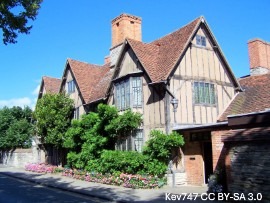
Stratford-upon-Avon home of Shakespeare's daughter is 'At Risk'
Lady Grange’s House repaired on St Kilda
.jpg)
National Trust for Scotland repairs stone cleit with link to famous island resident
Griff Rhys Jones on BBC Radio 4 Today programme
,_Green_Lane,_Derby.jpg)
The Victorian Society’s President unveiled its latest Top Ten Endangered Buildings 2026.
Need a MATE? Book your place now.

IHBC offers free webinars on applying for IHBC accreditation (Full & Associate).
UK Stained Glass Repository finds windows new homes
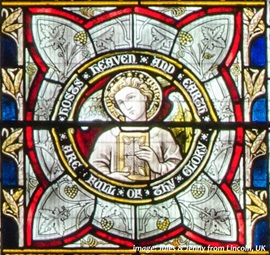
How are stained glass windows are rescued, stored and repurposed?
APPGEBE report sets high aims for quality
'Government must not sacrifice quality in drive to build 1.5m homes'
New measures protect Historic Shipwrecks from heritage crime

Underwater cultural heritage benefits from new HE guidance
How could the City of London skyline look in 6 years' time?

Visualisation shows approved planning applications as completed buildings
National Trust for Scotland calls for VAT cuts
Heritage neglect is encouraged by current policies
IHBC's 'Context' Issue 186 features Industrial Heritage
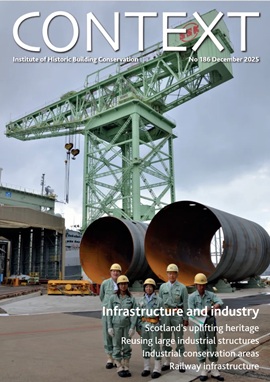
IHBC's members' journal reports on the challenges of conserving infrastructure
Book now for IHBC Annual School 2026
IHBC Annual School is taking place 18-20 June 2026 in Newcastle
RICHeS Research Infrastructure offers ‘Full Access Fund Call’
RICHeS offers a ‘Help’ webinar on 11 March
Latest IHBC Issue of Context features Roofing
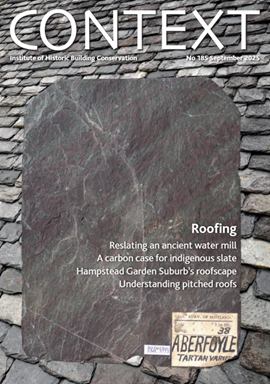
Articles range from slate to pitched roofs, and carbon impact to solar generation to roofscapes
Three reasons not to demolish Edinburgh’s Argyle House

Should 'Edinburgh's ugliest building' be saved?
IHBC’s 2025 Parliamentary Briefing...from Crafts in Crisis to Rubbish Retrofit
IHBC launches research-led ‘5 Commitments to Help Heritage Skills in Conservation’
How RDSAP 10.2 impacts EPC assessments in traditional buildings

Energy performance certificates (EPCs) tell us how energy efficient our buildings are, but the way these certificates are generated has changed.